

Introduction
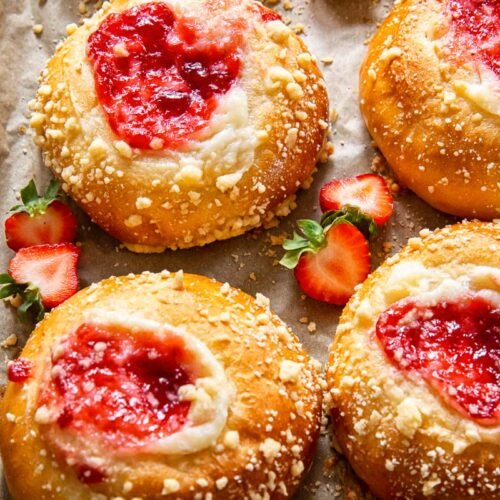
A sourdough strawberry cheesecake vatrushka bun is a beautiful fusion of traditional Eastern European baking, naturally fermented sourdough, and the irresistible flavors of strawberry cheesecake. It combines the soft, slightly tangy texture of a sourdough-enriched bun with a creamy cheesecake center and a bright, fruity strawberry topping. The result is a pastry that looks elegant enough for a bakery display but can also be prepared at home with patience and a few simple ingredients.
Traditional vatrushka is a round, open-faced bun associated with Eastern European cuisines, particularly Russian and Ukrainian baking traditions. It is typically made from enriched yeast dough and filled with sweetened farmer’s cheese or tvorog. The dough is shaped into a circle with a central depression that holds the cheese filling, creating a distinctive appearance.
This modern variation replaces commercial yeast with an active sourdough starter and transforms the classic cheese filling into a cheesecake-inspired mixture. Fresh strawberries add natural sweetness, gentle acidity, vibrant color, and a summery aroma. A little vanilla and lemon zest bring all the flavors together, while the slow fermentation develops a more complex taste and a tender crumb.
Unlike a conventional cheesecake, this dessert does not require a springform pan, a water bath, or a separate biscuit crust. Instead, the enriched dough becomes the pastry base, the cream cheese filling creates the cheesecake layer, and the strawberries provide a fresh finishing touch.
Whether served for breakfast, afternoon tea, brunch, or dessert, sourdough strawberry cheesecake vatrushka buns offer a delightful balance of rustic tradition and contemporary pastry craftsmanship.
What Makes These Buns Special?

The secret to these buns lies in the contrast between their different textures and flavors.
- Naturally fermented dough: An active sourdough starter creates a gentle tang and helps develop the dough’s flavor during a long fermentation.
- Soft, enriched crumb: Milk, butter, egg, and sugar give the buns a tender, almost brioche-like texture.
- Creamy cheesecake filling: Cream cheese, sugar, vanilla, and egg combine to create a smooth, rich center.
- Fresh strawberry topping: Strawberries contribute sweetness, juiciness, and a refreshing fruity note.
- Golden bakery-style finish: An egg wash creates an attractive shine, while a little powdered sugar makes the finished pastries look especially inviting.
The sourdough flavor should remain subtle rather than overpowering. The goal is a delicate balance between the buttery bread, creamy cheese, and strawberries.
Ingredients
This recipe makes approximately 8 medium-sized buns.
1. For the sourdough bun dough
- 400 g bread flour
- 100 g active sourdough starter at 100% hydration
- 180 g whole milk, lukewarm or cool
- 1 large egg, approximately 50 g without the shell
- 55 g granulated sugar
- 60 g unsalted butter, softened
- 8 g salt
- 1 teaspoon vanilla extract
- Finely grated zest of half a lemon, optional
Use a lively starter that has risen after feeding and shows plenty of bubbles. A 100%-hydration starter contains equal weights of flour and water.
2. For the strawberry cheesecake filling
- 250 g full-fat cream cheese, softened
- 45–55 g granulated sugar
- 1 egg yolk
- 1 teaspoon vanilla extract
- 1 teaspoon cornstarch
- 1 teaspoon lemon zest
- 1 tablespoon sour cream, optional
The cornstarch helps the filling set during baking, while the egg yolk adds richness. Sour cream contributes a slight tang and makes the filling taste more like classic cheesecake.
For the smoothest result, use block-style cream cheese rather than a very soft, spreadable product.
3. For the strawberry topping
- 200–250 g fresh strawberries
- 1–2 tablespoons sugar, depending on sweetness
- 1 teaspoon lemon juice
- 1 teaspoon cornstarch mixed with 1 teaspoon water, if needed
Choose strawberries that are ripe, fragrant, and firm enough to hold their shape. Wash them before removing the stems, then dry them thoroughly.
4. For finishing
- 1 egg beaten with 1 teaspoon milk for egg wash
- Powdered sugar for dusting, optional
- A little melted butter for brushing the baked edges, optional
Step-by-Step Preparation


Step 1: Prepare the sourdough starter
Begin by checking that your sourdough starter is active and healthy. Ideally, it should be used near its peak, when it has expanded noticeably after feeding and its surface appears bubbly.
A weak or inactive starter can make enriched dough particularly slow to rise because sugar, butter, and milk create a more demanding environment for fermentation.
If your starter has been stored in the refrigerator, feed it and allow it to become active before beginning the recipe.
Measure the starter carefully. Since it contains both flour and water, it contributes to the dough’s overall hydration. Avoid adding extra flour immediately if the dough initially feels sticky; enriched dough often becomes smoother as gluten develops.
Step 2: Mix the dough
In a large mixing bowl, combine the active sourdough starter, milk, egg, sugar, and vanilla extract. Whisk until the starter is mostly dispersed throughout the liquid.
Add the bread flour and mix until no dry flour remains. The mixture may look rough and slightly sticky at this stage.
Cover the bowl and allow the dough to rest for approximately 20–30 minutes. This resting period gives the flour time to absorb the liquid and makes kneading easier.
Add the salt and begin kneading. Work the dough by hand or use a stand mixer fitted with a dough hook.
Once the dough begins to develop elasticity, gradually incorporate the softened butter in small portions. Allow each addition to become absorbed before adding the next.
Continue kneading until the dough becomes smooth, elastic, and stretchy. It should feel soft and slightly tacky rather than excessively wet.
Depending on your mixer and flour, kneading may take around 10–15 minutes in a stand mixer or somewhat longer by hand.
Step 3: Bulk fermentation
Transfer the dough to a lightly greased bowl and cover it.
Allow it to ferment at a moderate room temperature until it has expanded noticeably and looks aerated. Depending on starter strength and temperature, this may take approximately 4–7 hours, sometimes longer.
Do not rely entirely on the clock. Enriched dough generally ferments more slowly than lean sourdough because its sugar and fat content can slow microbial activity.
During the first two hours, you can perform two or three gentle sets of stretch-and-folds if the dough needs additional strength.
To perform a fold, lift one side of the dough, stretch it gently, and fold it over the center. Rotate the bowl and repeat around the dough.
The dough should gradually become more cohesive and elastic.
It does not always need to double during bulk fermentation. A noticeable increase in volume, a smoother surface, and visible airiness are useful indicators that fermentation is progressing.
Step 4: Prepare the cheesecake filling

While the dough ferments, prepare the filling.
Place the softened cream cheese in a bowl and beat it until smooth. Add the sugar and mix until the mixture looks creamy.
Add the egg yolk, vanilla extract, lemon zest, cornstarch, and optional sour cream. Stir until everything is evenly combined.
Avoid beating excessively after adding the egg yolk, since incorporating too much air can encourage the filling to puff during baking and then sink unevenly as it cools.
Cover and refrigerate the filling until needed. Chilling helps it maintain its shape when spooned into the buns.
The finished mixture should be thick enough to hold a shallow mound on a spoon. If it is very loose, check that the cream cheese is not overly soft and that the ingredients have been measured correctly.
Step 5: Prepare the strawberries
Wash the strawberries and dry them thoroughly. Remove the green tops and cut the fruit into small pieces.
Combine the strawberries with the sugar and lemon juice. Leave them for approximately 10 minutes so the sugar can draw out some of their natural juices.
If the strawberries release a large amount of liquid, drain off the excess. Too much moisture can make the cheesecake filling watery and prevent the dough around the center from baking properly.
For a more concentrated strawberry flavor, gently simmer the strawberries in a small saucepan for several minutes until some of the liquid evaporates. If necessary, stir in a little cornstarch slurry and cook until the mixture thickens.
Allow cooked strawberry topping to cool completely before using it.
For a fresher appearance, you can also reserve some finely diced raw strawberries and add them in small quantities directly before baking.
Step 6: Divide and shape the buns


When the dough has fermented sufficiently, transfer it to a lightly floured work surface.
Divide it into eight equal pieces, approximately 105–110 g each. Shape each piece into a smooth ball by folding the edges underneath and gently rolling it against the work surface.
Place the dough balls on a parchment-lined baking tray, leaving enough space between them for expansion.
Cover them and allow them to rest for approximately 15–20 minutes. This short rest relaxes the gluten and makes the dough easier to shape.
To create the traditional vatrushka form, press the center of each dough ball with the bottom of a small glass or the fingers of your hand.
Make a broad, shallow depression while leaving a raised border around the edge. The border will form the golden rim that holds the filling.
If the dough springs back, allow it to rest for another five minutes before pressing again.
Take care not to press all the way through the bottom of the dough. The central well should be deep enough for the filling but still have a layer of dough underneath.
Step 7: Add the cheesecake and strawberry filling
Spoon approximately 30–35 g of cheesecake mixture into each depression, spreading it gently without covering the raised dough border.
Add a small spoonful of cooled strawberry topping to the center of each bun. You can swirl it lightly into the cheesecake mixture or arrange the pieces decoratively on top.
Avoid overfilling the buns. Excessive filling can spill over the sides during baking, and wet fruit can leave the dough underneath undercooked.
For a polished bakery-style appearance, keep the strawberry pieces concentrated in the middle and leave a visible ring of cream cheese around them.
Step 8: Final proof
Cover the shaped buns loosely and leave them at room temperature until the dough becomes visibly puffy and lighter.
This stage may take approximately 1–3 hours, depending on the temperature of your kitchen and the strength of your starter.
The dough should look relaxed, with slightly expanded edges. A gentle press on an exposed section of dough should leave an indentation that returns slowly rather than snapping back immediately.
If the buns still look dense and tight, give them more time. Baking before adequate proofing can produce heavy buns with a tight crumb.
Because the cheesecake filling contains egg and dairy, avoid leaving the assembled pastries at warm room temperature for an excessively long period. If fermentation is unusually slow, refrigerate the filled buns rather than allowing them to sit out indefinitely, and allow for additional proofing time after chilling.
Step 9: Apply the egg wash and bake

Preheat the oven to 180°C conventional heat, or approximately 170°C with a fan.
Brush the exposed dough borders lightly with egg wash. Avoid brushing too much egg onto the cheesecake filling because it can alter the surface appearance.
Bake the buns for approximately 20–28 minutes, rotating the tray if your oven heats unevenly.
The dough borders should become golden brown, and the cheesecake centers should appear set around the edges. A slight wobble in the very center can be normal, especially while the filling is hot.
If the buns brown too quickly, loosely cover them with foil for the remainder of the baking time.
For the most reliable results, check that the bread is fully baked and that the egg-containing filling reaches a food-safe internal temperature of 71°C (160°F).
Transfer the buns to a cooling rack.
The cheesecake filling will continue to firm as the pastries cool, so allow them to rest before serving.
Step 10: Finish and serve
Once the buns have cooled until warm or reached room temperature, dust them lightly with powdered sugar if desired.
For an extra glossy finish, brush the strawberry topping with a little warm, smooth strawberry jam. This is optional but gives the pastries an attractive bakery-style shine.
A few thin slices of fresh strawberry, a touch of lemon zest, or a small mint leaf can be used as decoration immediately before serving.
These buns are particularly delicious when the bread is soft, the cheesecake filling is creamy, and the strawberry topping still tastes bright and fruity.
Understanding the Flavor and Texture
The success of a sourdough strawberry cheesecake vatrushka depends on balancing three distinct components.
The bread should be tender rather than chewy. Butter and egg soften the crumb, while milk adds richness. Proper gluten development gives the dough enough structure to hold its shape without becoming tough.
The cheesecake filling should be smooth and gently sweet. Cream cheese provides the familiar cheesecake flavor, while vanilla adds warmth and lemon zest keeps the richness from becoming overwhelming.
The strawberries provide contrast. Their natural acidity complements the tang of the sourdough and cream cheese, while their color makes the buns visually appealing.
Sourdough fermentation adds complexity, but the final flavor depends on the starter, fermentation time, temperature, and flour. A longer fermentation can create more pronounced acidity, while a healthy starter and moderate fermentation generally produce a milder result.
The ideal bun tastes buttery and slightly tangy, with a soft center, a delicate golden crust, and a creamy strawberry cheesecake filling.
Tips for Perfect Results
- Use an active starter. Enriched dough needs reliable fermentation to become light and airy.
- Measure ingredients by weight. A kitchen scale improves consistency, especially when working with sourdough.
- Add butter gradually. This helps the dough develop a stronger gluten network.
- Keep the strawberries relatively dry. Excess liquid can soak into the dough and weaken the filling.
- Create a deep enough well. A shallow depression may cause the filling to spread over the raised edges.
- Avoid overfilling. A moderate amount of cheesecake and strawberry mixture gives a better bread-to-filling ratio.
- Watch the dough, not just the clock. Fermentation speed varies with starter activity and room temperature.
- Let the buns cool before moving them. The filling is delicate while hot and becomes more stable as it cools.
Common Problems and How to Fix Them
The buns are dense
The most likely causes are an inactive starter, insufficient fermentation, or underproofing after shaping. Give the dough enough time to become aerated before baking, and check that your starter rises predictably after feeding.
The filling becomes watery
Fresh strawberries naturally release liquid, especially when combined with sugar. Drain excess juice, cook the topping briefly if necessary, and cool it before adding it to the buns.
The cheesecake cracks
Cracking can occur when the filling contains excess air or is baked too aggressively. Mix gently after adding the egg and avoid unnecessarily high oven temperatures.
The bottoms remain pale or undercooked
The filling may be too wet, the dough may be underproofed, or the buns may need additional baking time. Use a fully preheated oven and avoid placing the tray too high in the oven.
The buns spread too much
The dough may be too soft, insufficiently developed, or overproofed. Measure the liquid accurately, knead until the dough is elastic, and handle the shaped buns gently.
Flavor Variations


Once you master the basic recipe, you can adapt it to different seasons and flavor preferences.
- Strawberry lemon cheesecake: Increase the lemon zest slightly and add a small amount of lemon juice to the filling.
- Strawberry chocolate: Sprinkle a few finely chopped dark chocolate pieces over the strawberry topping before baking.
- Raspberry cheesecake: Replace the strawberries with raspberries for a sharper, more intense fruit flavor.
- Blueberry vanilla: Use blueberries and a little extra vanilla for a mellow, sweet variation.
- Strawberry almond: Add a small amount of almond extract to the filling and sprinkle sliced almonds over the dough border.
- Honey cheesecake: Replace some of the granulated sugar in the filling with a little honey, reducing the amount of other liquid ingredients if necessary.
For the best texture, keep the total amount of fruit moderate. Very wet fruits may need to be cooked down before they are added to the cheesecake center.
Storage and Make-Ahead Instructions
These buns contain cream cheese, egg, and fresh fruit, so they should be handled like other perishable dairy-filled pastries.
Allow them to cool, then refrigerate them in an airtight container within two hours of baking. Store at or below 4°C and consume within approximately three to four days.
For the best texture, warm an individual bun briefly in a low oven, around 150°C, until the bread softens and the center is gently warmed. Avoid prolonged heating, which can dry out the dough and cause the filling to overcook.
You can prepare the dough the day before baking. After the initial fermentation has progressed, refrigerate it in a covered container to slow its activity. Shape the buns the following day, allow them to warm and proof appropriately, then add the filling and bake according to the recipe.
You can also prepare the cheesecake mixture and strawberry topping in advance and refrigerate them separately. This makes assembly easier on baking day.
Freezing is possible, although fresh strawberries may soften and release moisture after thawing. For the best quality, freeze fully cooled buns in a single layer before transferring them to a freezer-safe container. Thaw in the refrigerator and reheat gently. The texture of the filling and fruit may be less pristine than when freshly baked.
Serving Suggestions
Sourdough strawberry cheesecake vatrushka buns are versatile enough for several occasions.
Serve them slightly warm with coffee for a relaxed breakfast, or arrange them on a platter for a weekend brunch. Their creamy centers also make them suitable for afternoon tea, garden gatherings, birthday celebrations, and spring or summer dessert tables.
For a more elaborate dessert, pair a bun with fresh strawberries, a spoonful of lightly whipped cream, or a small scoop of vanilla ice cream. A little lemon zest can brighten the presentation without adding excessive sweetness.
If serving guests, allow the buns to cool until the cheesecake centers are set. This makes them easier to handle and gives the filling a more attractive appearance when cut or pulled apart.
Frequently Asked Questions
Can I use sourdough discard?
This recipe is designed for an active starter because the starter provides the primary leavening. Unfed discard alone may not raise the enriched dough adequately. You can use discard in a modified recipe that includes another leavening method, but the fermentation and texture will differ.
Can I use frozen strawberries?
Yes. Thaw them first, drain away excess liquid, and cook them briefly if needed to create a thicker topping. Cool completely before assembling the buns.
Can I use ricotta instead of cream cheese?
Yes, but the filling will have a lighter, less tangy texture. Drain the ricotta well and adjust the sugar and cornstarch as needed to keep the mixture thick.
Are these buns very sour?
They should not be aggressively sour. An active starter, moderate fermentation, and an enriched dough usually produce a gentle tang that complements the cheesecake and strawberries.
Can I make the buns without a stand mixer?
Absolutely. Knead by hand, adding the butter gradually. The process takes more effort, but it can produce excellent results. Allow the dough to rest briefly if it becomes difficult to handle.
How do I know when the buns are fully baked?
Look for golden borders, a set cheesecake filling, and a fully baked bread base. If using a food thermometer, ensure the egg-containing filling reaches 71°C (160°F).
Conclusion
Sourdough strawberry cheesecake vatrushka buns bring together the comforting character of traditional Eastern European cheese buns and the indulgent flavors of a modern strawberry cheesecake. Their appeal comes from the harmony of soft, naturally fermented bread, smooth vanilla cream cheese, and sweet-tart strawberries.
Although the process involves several stages, each step serves a purpose: fermentation develops flavor, kneading builds structure, shaping creates the classic vatrushka well, and careful baking sets the filling while keeping the bread tender.
The most important principles are to use an active starter, allow sufficient proofing time, control the moisture in the strawberry topping, and avoid overfilling the dough.
With these details in mind, you can create eight beautiful buns that are fragrant, creamy, colorful, and satisfying. They offer a wonderful way to experiment with sourdough beyond ordinary loaves while creating a pastry that feels both traditional and special.
Serve them fresh, share them with friends, or enjoy one slowly with a cup of coffee. Each bun delivers a little of the warmth of homemade bread, the richness of cheesecake, and the fresh sweetness of strawberries in a single delightful pastry.